
Description
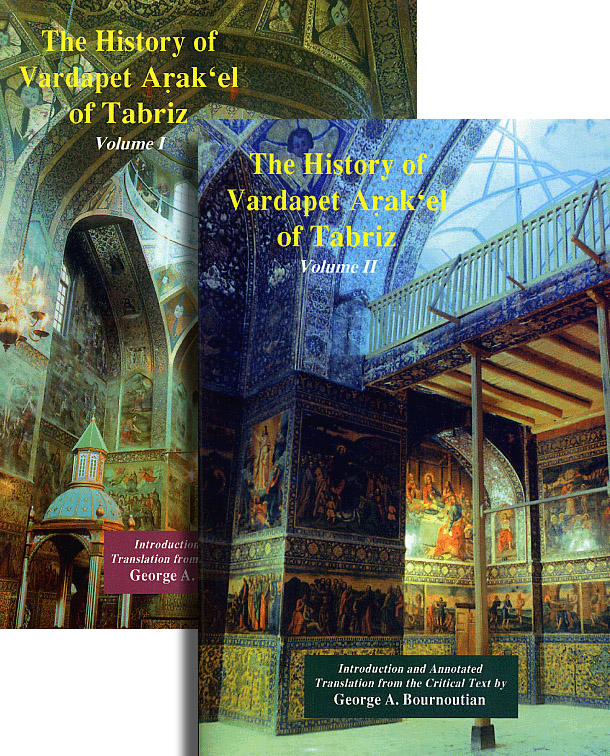
The History or Book of Histories by Arak‘el of Tabriz is the most important seventeenth-century Armenian source on the history of Persia and Armenia. Volume II ends in the year 1668 and deals with the establishment of important monastic schools in Armenia, the list of prominent vardapets, the biographies and martyrdom of various Armenian clerics, the genealogy of the Ottoman and Safavid monarchs, the names and properties of gemstones, as welt as, various earthquakes and eclipses. An important part of Arak‘el’s work is the order of succession of the kat‘oghikoi and the appearance of numerous coadjutors at the Holy See of Ejmiatsin from 1441 to 1655. Arak‘el devotes two chapters to the Jewish communities living in the Persian and Ottoman Empires. The first deals with the Jews of Isfahan and other cities of Persia. The second concerns the unique messianic movement of Sabbatai Sevi, which took place in Izmir. One of the most important and lengthiest chapters is a chronology of significant events, which occurred in Armenia, Persia, and the Ottoman Empire from 561 to 1668. This, the first English translation of Arak‘el’s History, will enable students to better understand the history of Persia, Georgia, eastern Armenia, and the Ottoman Empire during a crucial period.
Vardapet Arak‘el of Tabriz (d. 1670). The History of Father Arak‘el is the most important Armenian primary source dealing with contemporary events that occurred in Iran, Armenia, Ottoman Empire, and Georgia from 1602 to 1662. It describes the Jelali Revolt; the Armenian Community in Poland and its struggle against and eventual loss to Roman Catholicism, the corruption and decline of the Holy See of Ejmiatsin in the first half of the seventeenth century and its revival in the second half of that century. The life and acts of the various Armenian Kat‘oghikoi (Supreme Patriarchs) are especially interesting, since the author was present at the Holy See and privy to its inner secrets. It also details account of numerous martyrdoms; a rare and informative chapter on the Jewish community of Isfahan and their forced conversion to Islam; and four chapters on the history of Georgia. The founding and history of the famous monastic schools and hermitages are described in great details. Most importantly, the book has the best description of the forcible settlement of the Armenians in Iran by Shah Abbas I and its aftermath. This, the first English translation, will be of great use to scholars of Iranian, Armenian, Ottoman, and Georgian history.